The Beginning
CVC was founded in early 2017 with a vision to develop and build tiny home units in partnership with people experiencing homelessness. The Beloved Community Village (BCV) was the first of its kind in Denver and gained traction as a valuable solution for emergency shelter while program participants worked toward stable housing opportunities. Since those original 11 units, CVC has grown to operate 150 units across three Micro-Communities in 2026, in addition to operating the Safe Outdoor Space program from 2020-2025.
Our Approach
From the beginning, CVC’s strategic approach has been based on decades of research demonstrating that shelter-first programs are more effective at reducing homelessness and improving individual stability compared to traditional congregate models. For many people experiencing homelessness, traditional congregate shelters are unwelcoming, unsafe, or inaccessible. Our approach also acknowledges that providing a safe living environment is a critical first step in addressing the complex needs of people experiencing homelessness. Research consistently shows that shelter-first programs are more effective than traditional models, and are proven to have a widespread positive effect on the broader community through decreased emergency service utilization, fewer incarceration incidents, mental/behavioral management, and economic growth. CVC is committed to addressing and bridging the gaps in services for people experiencing homelessness by offering low-barrier, trauma-informed shelter in an equitable manner that amplifies the voices of those experiencing homelessness and empowers them to be part of the solutions.
The Data Shows…
- Over 10,000 people are experiencing homelessness in metro Denver, with nearly 800 experiencing unsheltered homelessness in Denver.(Metro Denver Homelessness Initiative Point in Time Count)
- The cause of homelessness is primarily economic related, such as loss of employment, inability to pay rent/mortgage, and family dissolution. (2023 Colorado Coalition for the Homeless State of Homelessness Report)
- 40% of individuals say their financial stability is worse or much worse than one year ago, and 30% say they are worried or very worried about losing housing because they can't afford the monthly rent or mortgage (2025 Colorado Health Foundation Pulse Poll)
- 56% of individuals have experienced mental health strain such as anxiety, depression, loneliness, or stress over the past year. (2025 Colorado Health Foundation Pulse Poll)
About Shelter
Street Outreach refers to activities that are designed to meet the immediate needs of people experiencing homelessness in unsheltered locations. Street outreach teams go directly to where people are living and provide immediate support and connection to services. The Safe Outdoor Spaces are the product of street outreach activities.
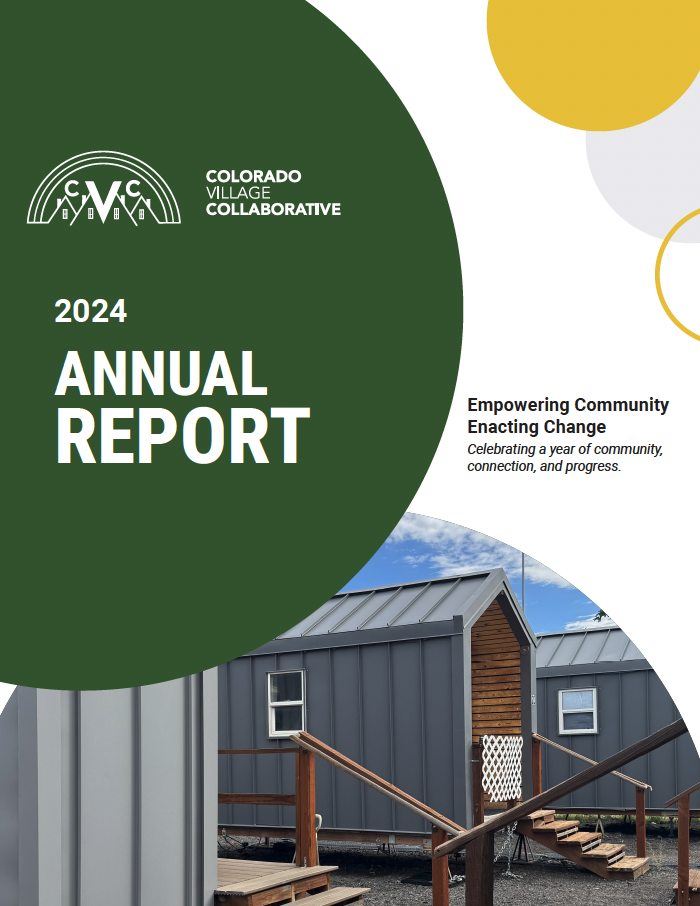
Emergency Shelter aims to increase the quantity and quality of temporary shelters. This is the Tiny Home Village and Micro-Community model. All CVC sites provide shelter and basic necessities, 24/7 staff, three meals per day, hygiene facilities, and supportive services, including case management, mental health care, and peer support. CVC currently operates three micro-communities: Monroe, Steele, and La Paz.
Other models:
Tiny Home Villages: Now known as Monroe Village, the site operates over two adjacent villages, the Welcome Village and Beloved Village. This site now operates as a Micro-Community.
Safe Outdoor Spaces: Launched in December 2020 to respond quickly to the COVID-19 pandemic in partnership with the City and County of Denver, CVC operated nine Safe Outdoor Spaces in the Denver metro area between 2020-2025. These SOS sites provide resources and services in a healthy and secure environment that is staffed 24/7. This innovative model provides outdoor, individualized shelter and a pathway into stable housing for people experiencing homelessness in Denver. The final SOS site was wound down in early 2025, retiring the model.
More Info